Home · The planet
The planet
Earth’s closest planetary neighbour
Venus is the second planet from the Sun, and Earth’s closest planetary neighbour. [NASA Science] Venus is named for the ancient Roman goddess of love and beauty. Most features on Venus are named for women. [NASA Science] Venus is the third brightest object in the sky after the Sun and Moon, and the brightest object in the night sky after the Moon. [NASA Science]
Venus is similar in structure and size to Earth, and is sometimes called Earth’s twin. [NASA Science] The equatorial radius is 6,051.8 km, about 0.949 times Earth’s. [NASA Fact Sheet] Venus has a mass of 4.8673 × 10²⁴ kg, about 0.815 times the mass of Earth. [NASA Fact Sheet] Mean surface gravity is 8.87 m/s², about 0.903 times Earth’s. [NASA Fact Sheet]
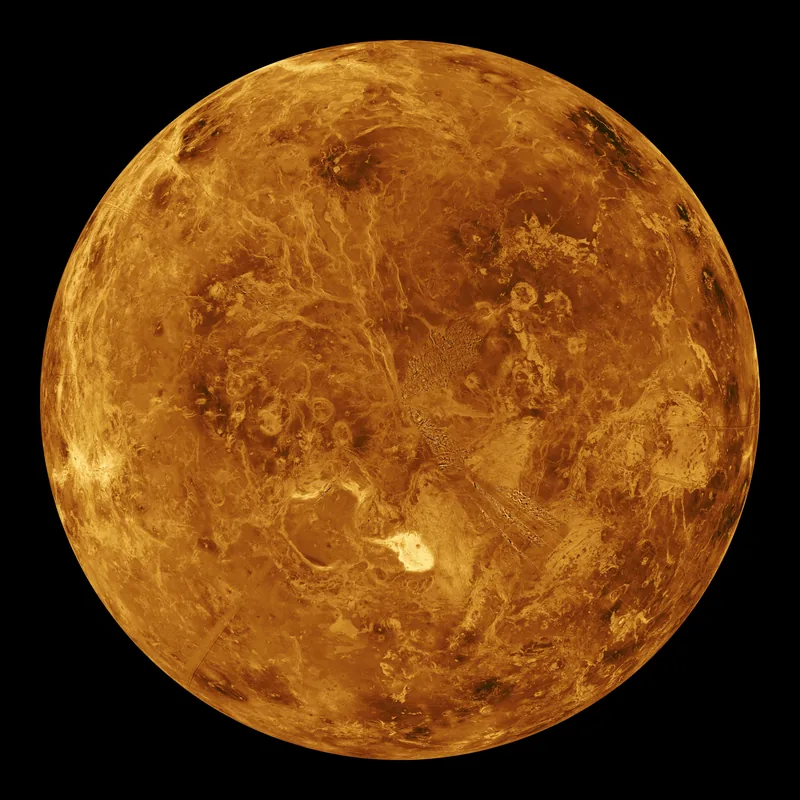
Venus orbits the Sun at a semimajor axis of 108.210 million km, with a sidereal orbit period of 224.701 Earth days. [NASA Fact Sheet] The sidereal rotation period is −5,832.6 hours, 243.690 times as long as Earth’s, and the rotation is retrograde. [NASA Fact Sheet] The length of a solar day on Venus, on the fact sheet, is 2,802.0 hours, or 116.750 Earth days. [NASA Fact Sheet] Venus spins slowly in the opposite direction from most planets, so the Sun would rise in the west and set in the east. [NASA Science] NASA Science gives a sidereal day of 243 Earth days, longer than a Venus year of 225 Earth days. [NASA Science]
The obliquity of Venus to its orbit is 177.36 degrees. [NASA Fact Sheet] NASA Science gives Venus a very slight tilt of only three degrees, too little to produce noticeable seasons. [NASA Science]
Venus is one of only two planets in our solar system that does not have a moon, and it has no rings. [NASA Science] The fact sheet lists no natural satellites and no planetary ring system. [NASA Fact Sheet]
The phases of Venus, first observed by Galileo through his telescope, provided key scientific proof for the Copernican, heliocentric picture of the solar system. [NASA Science]