Venus is the second planet from the Sun, and Earth’s closest planetary neighbour. [NASA Science] It is the hottest planet in our solar system — hotter, NASA Science notes, even than Mercury. [NASA Science] Its thick atmosphere traps heat in a runaway greenhouse effect, with surface temperatures hot enough to melt lead — about 872 °F (467 °C), according to NASA Science. [NASA Science]
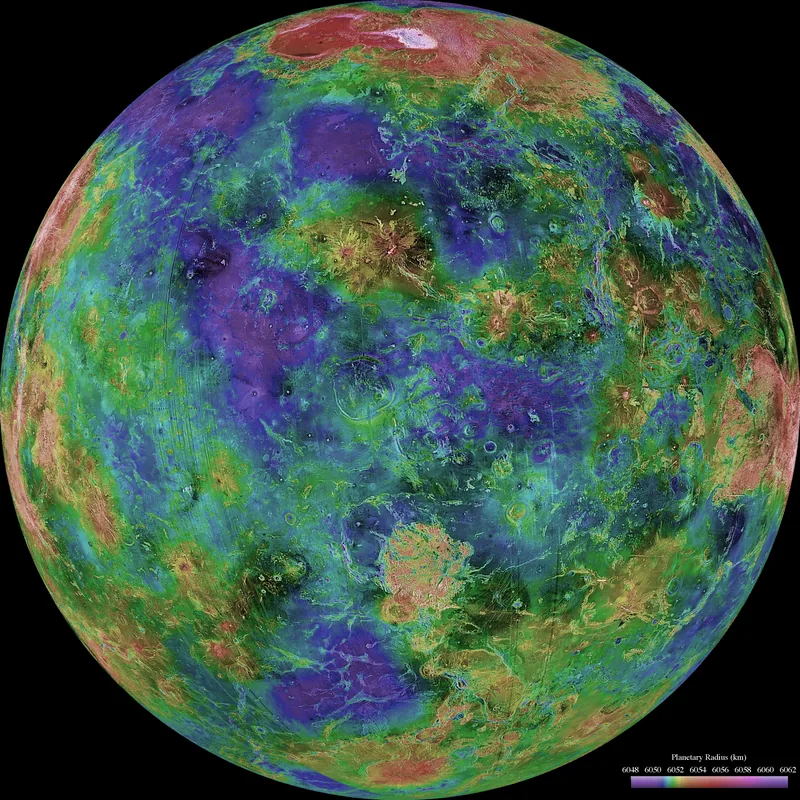
A hemispheric radar view of Venus, centred at 0° east longitude, from more than a decade of radar work culminating in NASA’s Magellan mission of 1990–1994. This is a radar mosaic, not a visible-light photograph of the surface.NASA / JPL / USGS · Public Domain (NASA)
Venus is similar in structure and size to Earth, and is sometimes called Earth’s twin. [NASA Science] Venus spins slowly in the opposite direction from most planets, so the Sun would rise in the west and set in the east. [NASA Science] NASA Science gives a sidereal day of 243 Earth days, longer than a Venus year of 225 Earth days. [NASA Science] NASA Science puts the atmospheric pressure at the surface at about 93 times what it is at sea level on Earth. [NASA Science]
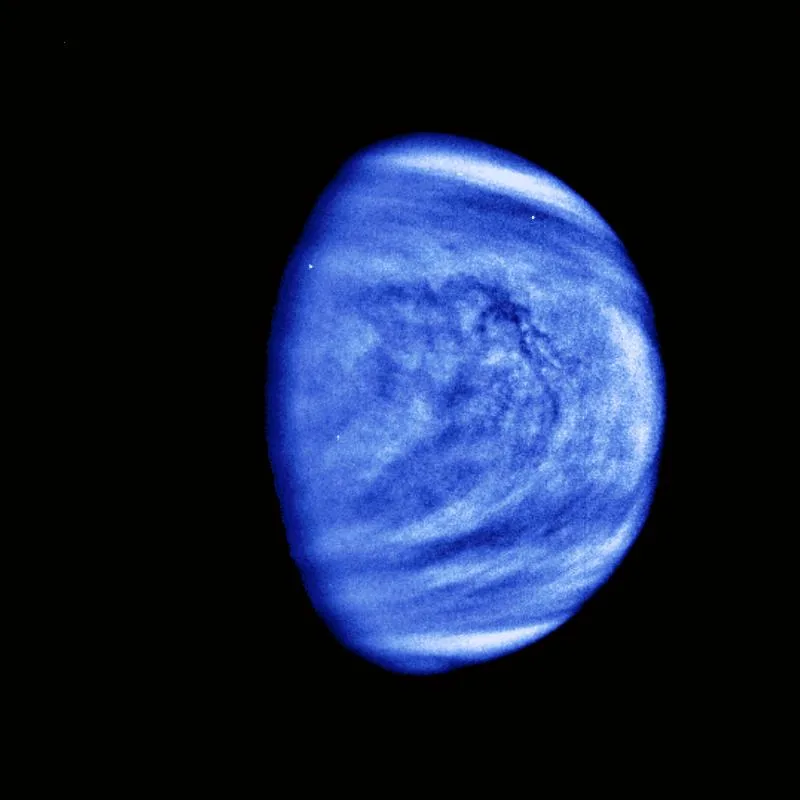
Cloud patterns on Venus, photographed by the Galileo spacecraft’s Solid State Imaging System on 14 February 1990, from almost 1.7 million miles (about 2.7 million kilometres). The published frame is colourised and filtered; it shows the cloud tops, not the ground.NASA / JPL · Public Domain (NASA)
The atmosphere is mostly carbon dioxide, with dense clouds composed of sulfuric acid. [NASA Science] Below the dense, persistent clouds, the surface has volcanoes and deformed mountains. [NASA Science]
Open the surface-conditions desk to put Venus next to Earth, and to see the NASA fact sheet next to NASA Science when the rounded figures differ.