Home · Atmosphere
Atmosphere
A runaway greenhouse
Its thick atmosphere traps heat in a runaway greenhouse effect, with surface temperatures hot enough to melt lead — about 872 °F (467 °C), according to NASA Science. [NASA Science] Surface temperatures are hot enough to melt lead. [NASA Science] It is the hottest planet in our solar system — hotter, NASA Science notes, even than Mercury. [NASA Science]
The same fact sheet gives the average surface temperature as 737 K (464 °C). [NASA Fact Sheet] On NASA’s comparative planetary fact sheet, the mean temperature of Venus is 464 °C, against 15 °C for Earth and 167 °C for Mercury. [NASA Fact Sheet] The fact sheet lists the diurnal temperature range as about zero. [NASA Fact Sheet]
The NASA fact sheet gives the surface pressure as 92 bars. [NASA Fact Sheet] NASA Science puts the atmospheric pressure at the surface at about 93 times what it is at sea level on Earth. [NASA Science] The same comparative table lists a surface pressure of 92 bars for Venus and 1 bar for Earth. [NASA Fact Sheet]
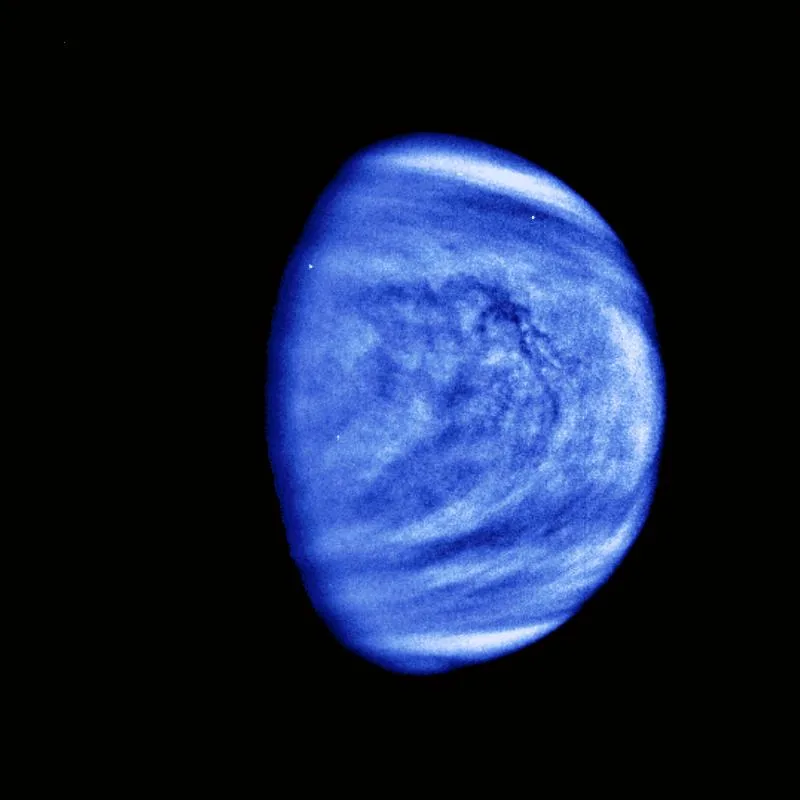
Near the surface, by volume, the atmosphere is 96.5% carbon dioxide (CO₂) and 3.5% nitrogen (N₂). [NASA Fact Sheet] The atmosphere is mostly carbon dioxide, with dense clouds composed of sulfuric acid. [NASA Science] The Bond albedo is 0.77, about 2.6 times Earth’s. [NASA Fact Sheet]
Venus does not have its own internally generated magnetic field. It has a weak induced magnetic field, created by the interaction of the Sun’s magnetic field with the planet’s outer atmosphere. [NASA Science] That table also marks Venus as having no global magnetic field, against “Yes” for Earth. [NASA Fact Sheet]
Compare the figures side by side on the surface-conditions desk.